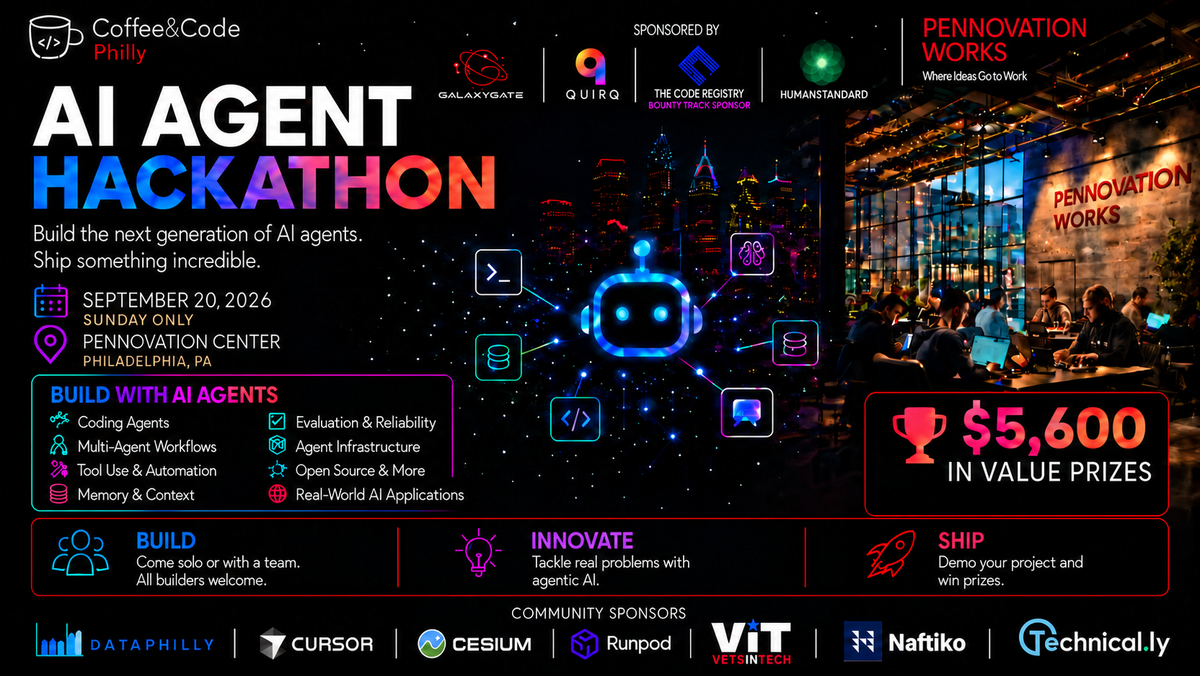
Build, experiment, and ship working AI-agent projects with developers from across Philadelphia.
| 📅 Sept. 20 & 22 |
📍 Philadelphia |
👥 Teams or Solo |
💻 In Person |
|
🚀 Register Register on Luma → |
👥 Meetup RSVP on Meetup → |
Join developers from across Philadelphia for a hands-on hackathon focused on building with AI agents.
Expect practical challenges, working prototypes, and experimentation with agentic systems. You can arrive with a team, meet collaborators at the event, build independently, or join without a finished project idea.
| 👥 Come with a team | 🤝 Find collaborators |
| 💻 Build independently | 💡 No finished idea required |
Developers, engineers, technical builders, and anyone interested in experimenting with AI-agent systems.
Whether you're experienced with agent frameworks or just starting to explore them, the goal is to build, test ideas, learn from others, and leave with something working.
🧠 What You Can Build With| Coding Agents | Multi-Agent Systems | Tool Use |
| Automation | Agent Memory & Context | Evaluation & Reliability |
| AI Safety | Open-Source Frameworks | Real-World Applications |
| 💻 | Laptop & charger |
| 🛠️ | Your development setup |
| 🔑 | API keys / tools you plan to use |
Two days. Two locations. One hackathon.
|
DAY 1 — BUILD DAY September 20 • Pennovation Center 3401 Grays Ferry Avenue, Philadelphia, PA 19146 |
| TIME | EVENT |
|---|---|
| 9:00 AM – 9:40 AM | Registration & Check-In |
| 10:00 AM – 10:15 AM | Opening Ceremony |
| 10:15 AM – 10:30 AM | Challenge Track Introductions |
| 10:32 AM – 10:35 AM | Quirq |
| 10:37 AM – 10:40 AM | The Code Registry |
| 10:42 AM – 10:48 AM | GalaxyGate & Runpod |
| 10:50 AM – 10:53 AM | Human Standard |
| 10:55 AM - 10:58 PM | Naftiko |
| 11:00 AM – 11:08 AM | Open Track / Bring Your Own Project |
| 11:10 AM – 6:00 PM | 🚀 Hackathon Build Time |
|
DAY 2 — AWARDS & COMMUNITY NIGHT September 22 • Cesium 601 Walnut Street, Suite 250S, Philadelphia, PA 19106 |
| TIME | EVENT |
|---|---|
| 6:00 PM | Arrival & Check-In |
| 6:15 PM – 7:00 PM | 🎤 Featured Speakers & Lightning Talks |
| 7:00 PM – 7:30 PM | 🏆 AI Agent Hackathon Awards |
| 7:30 PM+ | 🍕 Food & Networking |
Challenge tracks and awards are being finalized with participating partners.
|
🚧 Final challenge details are coming soon. Participating sponsors are finalizing their challenge prompts, judging criteria, and prize details. This page will be updated as each track is confirmed. |
|
🚀 Ready to Build?
Join developers from across Philadelphia and build something with AI agents. Register on Luma → | RSVP on Meetup → |
The Quirq Challenge: build an agent—or try to break its workspace.
Agents can run for hours, consume tokens, modify files, and call tools—but it is often difficult to see what they actually did or determine whether they stayed within their intended boundaries. That is the problem Quirq works on.
This challenge has two tracks: Build It and Break It.
Quirq: Build It
Build any useful agentic system and run it through Quirq, using either the managed cloud at app.xo.builders or the local runtime. You may use Claude Code, Codex, OpenClaw, Hermes, n8n, your own agent, or another runtime.
Your project can solve any problem and may also compete in another hackathon track. What matters here is that your agent performs meaningful work and that its activity is visible through the xo-space: its environment, sessions, actions, files changed, costs, and results.
You are not only being judged on whether your agent works. You are also being judged on whether people can understand what it did, evaluate its output, and trust how it operated.
Judging criteria:
- Agentic Design & Execution — 30%
- Observability & Space Display — 25%
- Impact & Usefulness — 25%
- Reliability & Safety — 20%
Prize: $500 cash plus an equivalent amount in Quirq credits. One winner.
Quirq: Break It
Test the security and integrity of your own cloud-managed Quirq workspace at app.xo.builders.
Look for ways to escape the intended workspace scope, conceal agent activity from the xo-space, misreport usage, bypass controls, or otherwise cause the workspace to behave in an unsafe or unexpected way.
Each finding must be submitted privately and include clear reproduction steps, an explanation of its impact, and a suggested fix. Do not test other participants’ workspaces, disrupt shared infrastructure, or target Code & Coffee systems, the local Quirq installation, or third-party model providers.
Validated findings earn points based on:
- Severity and impact
- Reproducibility
- Novelty
- Scope and systemic impact
- Quality of the report
Bounty: Up to $500 total may be distributed across accepted findings. Awards depend on the quality and severity of validated findings; the full bounty is not guaranteed. Invalid, duplicate, low-impact, or non-reproducible reports may receive reduced points or no payout.
THE CODE REGISTRY CHALLENGE: BUILD FAST, THEN PROVE IT HOLDS UP.
Today you will generate a lot of code, and most of it will be written by an agent. Almost none of it will be read by a human. That is the problem we work on.
The Code Registry analyses a codebase and returns a Code Score out of 1,000 across three pillars: Security, Dependencies and Quality. There is no LLM anywhere in the analysis pipeline. It is deterministic, so the same code returns the same score every time.
This track runs across the whole event. Build whatever you want, in any language, for any other track. Then run your project through The Code Registry before the cutoff. The highest final Code Score wins.
You are not being judged on whether your agent works. You are being judged on what your agent produced.
Prize: a 12-month Code Registry plan covering up to 400,000 lines of code, listed value $3,600. One winner.
HUMANSTANDARD TRACK: BUILD FOR HUMAN MUSIC
Description:
HumanStandard is a forensic AI music detection company. Our API takes a track and returns a signed verdict on whether the audio was generated by AI, performed by humans, or is a hybrid of the two, along with the evidence behind that call. Distributors, DSPs, and rights holders use it to comply with the EU AI Act, DDEX labeling standards, and platform policies on AI content.
For this track, build anything that uses the HumanStandard detection API to solve a real problem in music. Some directions to get you started: a submission screener for a label or playlist curator, a browser extension that flags AI tracks on streaming pages, an artist tool that generates proof of human authorship, a catalog auditing dashboard, a Discord bot for music communities, or an agent that investigates suspicious releases end to end. We care most about ideas that a real person in the music industry would actually want to use.
This track is built for people who want to go into music tech. Beyond credits and a fellowship, the winning team gets direct introductions from Rasha Rahman, HumanStandard's founder, to companies across the music industry, and a working session on turning the project into something real. If you are looking for a way into this world, this is the track for you.
What you get during the hackathon:
-
A HumanStandard API key issued to your team on the morning of the hackathon, preloaded with 200 credits. One credit is one song scan. Keys are generated from the team email you provide at registration, so make sure that email is one your team actually checks.
-
API documentation and a quickstart you can hand to a coding agent.
-
Arian from HumanStandard will be on site all day to help with the API and answer questions. Rasha Rahman, HumanStandard's founder, will also be available throughout the hackathon and will hold an office hour window where you can bring your project for a critique.
Requirements
QUIRQ SUBMISSION REQUIREMENTS
All Quirq submissions must include:
-
A working prototype
-
A clear project description
-
A link to the project repository
-
A demo video of no more than three minutes
-
A list of the tools, models, frameworks, and runtimes used
-
The names of all team members
-
Setup and testing instructions
Quirq: Build It
Prize$500 total prize pool, with up to $50 awarded per winning agent.
Each hacker may submit multiple agents. Awards are evaluated at the agent level, so one hacker may receive multiple awards. A hacker with 10 winning agents may win the entire $500 prize pool.
Submission RequirementsYour submission must:
-
Run on Quirq using either the managed cloud at app.xo.builders or a local installation.
-
Show the xo-space during the demo video.
-
Clearly display the agent’s environment, activity, sessions, actions, files changed, costs, and results.
-
Explain the problem being solved and the work completed by each submitted agent.
-
Identify any safeguards, permission controls, evaluations, or failure-handling mechanisms used.
-
Link any relevant xo-space pull request and GitHub Discussion thread when submitting an open-source contribution.
Other agent runtimes are allowed. However, displaying the system’s activity through the xo-space accounts for 25% of the judging score.
Each agent should be submitted and demonstrated clearly enough to be evaluated independently.
Quirq: Break It
Submit one private report for each finding. Each report must include:
-
A clear title and summary
-
The affected feature or component
-
Step-by-step reproduction instructions
-
Evidence such as screenshots, logs, or a short video
-
The actual and expected behavior
-
An explanation of the security or operational impact
-
A suggested fix or mitigation
-
Any relevant environmental or configuration details
All testing must be limited to your own cloud-managed workspace on app.xo.builders. Reports must be submitted privately through the designated Quirq Discord channel before the submission cutoff.
Do not test other participants’ workspaces, disrupt shared infrastructure, publicly disclose findings before review, or target Code & Coffee systems, local Quirq installations, or third-party model providers.
THE CODE REGISTRY
Submission and eligibility requirements
- Standard Devpost submission by the event deadline
- One entry per team
- Repository must be public. Private repositories cannot be cloned for analysis and will not be scored
- Stop building at 17:30. The final 30 minutes are for registering with The Code Registry, creating a project, and starting the repository sync
- Hard deadline: the sync must be started before 18:00. Anything started after that is not considered
- Analysis does not need to complete by 18:00. It runs after you leave, and results are collected before the awards on 22 September
- Teams must log their team name, repository URL and Code Registry account email with us at the table before leaving
- Participants will not see their own Code Score during the event. Scoring is carried out by The Code Registry after the build window closes
- Participants must be over the age of majority in their country of residence (per main event rules)
- Submitting a project constitutes consent for The Code Registry to analyse the submitted code for judging purposes
- TCR staff, contractors and their immediate families are not eligible
THE HUMAN STANDARD SUBMISSION REQUIREMENTS
Start of hacking period: 09/20/2026, 10:00 AM (already set)
Deadline: 09/20/2026, 6:00 PM (already set)
Final Reminders (shown right before submit):
Before you submit to the HumanStandard track, make sure you have included the following. Submissions missing any of these will not be judged for the track.
-
A public code repository link.
-
A demo video of three minutes or less showing the project working end to end.
-
A short written description of the problem you are solving and who in the music industry would use it.
-
An explanation of how your project calls the HumanStandard API and what it does with the results.
-
Evidence of at least one real API call (a screenshot of a response or a log).
-
Every team member listed on the submission.
You must opt in to the HumanStandard prize on the submission form to be considered.
File Upload: Off (repo link and video are enough). Require videos: On.








Prizes
GalaxyGate
GalaxyGate 1000$ value compute credits
Quirq Bounty - Break it!
Quirq - Build it!
Prize: $500 cash + equivalent credits — guaranteed payout
THE CODE REGISTRY CHALLENGE
$3600 value prize, year of up to 400k lines of code. Full visibility and deterministic reporting on security, tech dept, compliance, AI-ROI, third party dependencies, and licensing within your code repository.
Hackathon idea is writing code and whoever gets the highest code score in that time wins the prize!
HumanStandard Track Winner
Prize breakdown:
The winning team receives the HumanStandard Fellowship, a package of four things:
10,000 API credits and expanded model access. Keep building after the hackathon with 10,000 credits plus access to detection models beyond the base API, including the hybrid model (AI vocals over human instrumentals) and the provenance model.
A feature to 50,000 people. Rasha Rahman, HumanStandard's founder, will present and share your project with HumanStandard's community of over 50,000 followers on Instagram and TikTok, an audience made up of musicians, producers, and people working in the music industry.
60 minutes of bookable time with Rasha. Use it however you want: career advice, startup critique, marketing and go to market advice, or help turning the project into something real. Email rasha@hsverify.com whenever you are ready to schedule, in one session or several.
Industry connections. After the session, Rasha will make personal introductions to a few people at the largest music and music tech companies in the world, chosen based on what you built and where you want to go.
HumanStandard Track Runner Up
5,000 HumanStandard API credits to keep building after the hackathon.
Bring your own Agent Project
Devpost Achievements
Submitting to this hackathon could earn you:
Judges

Tony Siu
Agent Software Engineer ||| - Zoominfo

satya veerendra Vegulla
Senior Engineering Manager/Principal Architect

Chase Lauer
Senior Network Engineer - GalaxyGate

Suraj Sharma
Founder - Quirq

Satvik Bhasin
Platform Engineer - Geico

Aditi Patodiya
Senior Software Engineer - Amazon

Chandler Samuels
Associate Director of Solutions Engineering - Curotec

Arun Aalla
Manager - Deloitte Digital

Bharat Patel
Lead Software Engineer, Data & AI at Intuit

Richie Singh
Venture Capital & AI @ Mucker Capital | AI Researcher & Engineer

Muhammad Rashid
Founder & CEO of CureOn

DakShith Ragupathi
Chief Business Development Officer, CureOn

Hasan Shameer
Software Engineer - Bristol Myers Squibb
Judging Criteria
-
Bring Your Own Project - Technical Execution
How well does the project work? Is the implementation technically sound and functional? -
Bring Your Own Project - Agentic Design
How meaningfully does the project use agents, tool calling, memory, planning, multi-agent workflows, or autonomous execution? -
Bring Your Own Project - Innovation & Creativity
How original is the idea, approach, or use of agent technology? -
Bring Your Own Project - Impact & Usefulness
Does the project solve a meaningful problem or provide clear value to users? -
Bring Your Own Project - Reliability & Safety
Does the team account for failure modes, evaluation, permissions, guardrails, or other reliability and safety considerations? -
Bring Your Own Project - Demo & Completeness
How clearly does the team demonstrate what they built, and how complete is the working prototype? -
Human Standard - Does it work?
The project runs and does what the team claims. The HumanStandard API is actually integrated and the verdict data is used in a meaningful way, not just displayed. -
Human Standard - Is it a real problem?
The team identified a genuine pain point for someone in the music industry, whether an artist, label, distributor, curator, platform, or fan. Bonus points for teams that can name who would use this and why they would care. -
Human Standard - Product quality
The user experience is thoughtful. Verdicts are communicated honestly and with appropriate uncertainty rather than as a binary "this is AI" claim. The project feels like the start of something a person could ship, not just a proof that the API responds. -
Human Standard - Music tech ambition
The team shows real curiosity about the music industry and a desire to keep building in it. This matters because the prize is largely career oriented: introductions, mentorship, and a fellowship are most valuable to people who want to pursue this path. -
Quirq Build it - 30% weight; Agentic Design & Execution
Meaningful use of agents, including tool calls, memory, planning, multi-agent collaboration, and autonomy. Most importantly: does the system actually work? -
Quirq Build it - 25% Observability & Space Display
How clearly the demo shows the environment, agents, and their activity—including files touched, sessions, and costs. The Quirq space must be part of the demo. -
Quirq Build it - 25% Impact & Usefulness
Whether the project solves a real problem for a real user. -
Quirq Build it - 20% Reliability & Safety
How well the project handles failure modes, scoped permissions, guardrails, and evaluation. -
Quirq Break It Bounty
Quirq Red Team Bounty is evaluated separately using a points-based system: Severity and impact, Reproducibility, Novelty, Scope or systemic impact, Quality of the report -
The Code Registry Bounty
Eligible projects will be analyzed using The Code Registry. The participant whose hackathon code receives the highest final Code Score will win.
Questions? Email the hackathon manager
Tell your friends
This site is protected by reCAPTCHA and the Google Privacy Policy and Terms of Service apply.